


Table of Contents
- Why Celtic Earrings Deserve a Place in Your Everyday Rotation
- Celtic Knot Earring Meaning and How It Shapes Your Style
- Match Earrings to Your Face Shape for a Flattering Finish
- Everyday Styling: From Boho Chic to Office Polish
- Celtic Earrings for Formal Wear: Weddings and Evening Events
- Pairing Celtic Pendants with Earrings Without Overdoing It
- Caring for Your Celtic Earrings to Keep Them Heirloom-Ready
- Conclusion: Make Your Celtic Earrings Part of Your Signature Look
- Frequently Asked Questions
Last Updated: September 9, 2026
Why Celtic Earrings Deserve a Place in Your Everyday Rotation
Celtic earrings are one of the few jewelry categories that bridge the gap between everyday wear and heirloom significance. Unlike trend-driven accessories that date quickly, a well-chosen pair of Celtic earrings carries centuries of symbolism while remaining versatile enough for jeans and a linen shirt or a formal evening gown. At Keith Jack, we design pieces inspired by the rugged West Coast of Scotland, and these motifs can transform a simple outfit into a statement of heritage.
The common misconception is that Celtic jewelry belongs only at weddings or cultural celebrations. In practice, the intricate patterns of a triquetra or a Celtic spiral work beautifully as subtle accents. A pair of small stud earrings adds texture without shouting, while drop earrings offer movement and flair for those who prefer a bolder presence.
Below, we’ll walk through how to match earrings to your face shape, coordinate them with casual and formal wardrobes, and pair them with pendants without visual clutter.
Celtic Knot Earring Meaning and How It Shapes Your Style
Celtic knot earring meaning centers on eternity, connection, and the unbroken paths of life, making them far more than decorative accessories. The triquetra, or Trinity knot, represents the interconnectedness of mind, body, and spirit or the three stages of life - Maiden, Mother and Wise Woman. while the Celtic spiral echoes growth and the natural cycles of life.
Understanding this symbolism changes how you wear them. A piece with deep cultural motifs feels intentional when chosen for a specific occasion, whether that is a family gathering or a personal milestone. The claddagh, for instance, speaks to loyalty and friendship, making it a thoughtful choice for a dinner with close friends rather than a board meeting.
When you select earrings with awareness of their heritage, they become conversation starters. Someone will ask about the thistle design or the intricate knotwork, and you will have a story to tell. That narrative depth is what separates handcrafted jewelry from mass-produced alternatives.
Match Earrings to Your Face Shape for a Flattering Finish
Face shape compatibility is the most overlooked factor in choosing Celtic earrings, yet it determines whether a pair flatters or overwhelms. The goal is to echo your natural bone structure, not fight it.
- Round faces benefit from long dangle earrings or drop earrings that create vertical lines and elongate the face.
- Oval faces are the most versatile; most styles work, but post earrings and small dangles keep the balance intact.
- Heart-shaped faces suit teardrop or triangular designs that narrow toward the ear lobe, drawing attention downward past the chin.
- Square faces soften with curved motifs like the Celtic spiral or circular knotwork, which counterbalance angular jawlines.
When choosing earrings, hold one earring against your face in a mirror and check the silhouette first. For those with longer faces, stud earrings with gemstone accents like emeralds add width without adding length.
Everyday Styling: From Boho Chic to Office Polish
The real test of any jewelry is whether it works on a Tuesday morning, not just at a gala. Everyday styling for Celtic earrings comes down to scale, metal choice, and the specific context of your day. Most styling guides stop at 'boho' or 'casual,' but the biggest opportunity is making these heritage pieces work in a professional setting without losing their character.
The Office-Approved Formula: Texture Over Ornament
In a boardroom or client meeting, the goal is to let the intricate knotwork read as texture, not decoration. A simple three-part rule for office styling is:
- Keep the silhouette small. Post earrings, small hoops with a Celtic knot charm, or studs keep the look polished.
- Match metal to your hardware. If you wear a silver watch or belt buckle, choose sterling silver earrings. If your glasses are gold-toned, opt for 14k gold. Consistency in metal creates an intentional, curated feel.
- Let the earrings be the only 'loud' piece. If you are wearing a patterned blouse or a bright scarf, the earrings should be the quietest element in the outfit. If you are in a solid navy or charcoal suit, the earrings become your accent.
A common pattern that works well: a crisp white shirt, a dark blazer, and a pair of small triquetra studs in sterling silver. The earrings can add a layer of personal narrative without undermining authority. Dangle earrings with movement are often saved for after-hours events or casual Fridays.
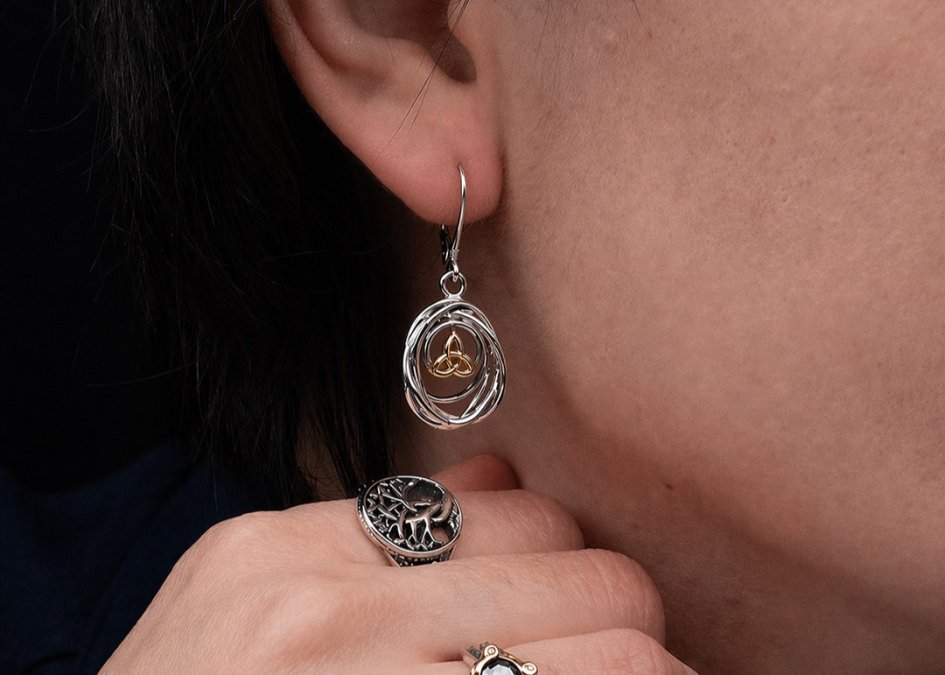
Celtic Cradle of Life Earrings
Building a Jewelry Capsule Around Your Celtic Pieces
A jewelry capsule is a small collection of pieces that mix effortlessly with your wardrobe and with each other. The principle is the same as a clothing capsule: every piece should work with at least three outfits, and ideally with each other.
Here is a practical capsule framework built around Celtic earrings:
- The Foundation Pair: A pair of small Celtic knot or spiral studs in sterling silver. These are your default Monday-to-Friday earrings. They work with everything from a hoodie to a blazer.
- The Modern Minimalist Bridge: One pair of simple hoop earrings or small silver and gold drops. This allows you to mix metals intentionally. Wear them with a Celtic pendant on a silver chain for a layered, contemporary look that avoids the 'matchy-matchy' trap.
- The Statement Anchor: One pair of medium-drop Celtic earrings with a gemstone accent (like emerald or amethyst). These are for days when you need a confidence boost or have an important presentation.
- The Boho Weekend Pair: One pair of larger, textured drop earrings. These are for farmer's markets, gallery openings, or casual dinners.
Seasonal Adjustments for Everyday Wear
Your earrings should shift with the seasons, not just your wardrobe. In winter, heavy knitwear and turtlenecks call for smaller studs that won't get lost in the fabric or snag on wool. In summer, when you're wearing lighter linens and open necklines, drop earrings have room to move and catch the light. A common mistake is wearing the same pair year-round; adjusting for season keeps the look fresh and prevents the earrings from feeling like a uniform.
Celtic Earrings for Formal Wear: Weddings and Evening Events
Celtic earrings for formal wear deserve their own consideration because the stakes are higher and the lighting is unforgiving. For weddings, evening galas, or milestone celebrations, choose pieces with presence: drop earrings in sterling silver, vermeil, or silver and gold mixed metal with intricate knotwork and gemstones that catch the light.
The dress code dictates the scale. A floor-length gown pairs well with longer dangle earrings that frame the neckline. A cocktail dress calls for medium drops or statement studs with gemstone accents such as emerald or amethyst. The key is to let the earrings complement the neckline without competing with it.
For those attending a wedding as a guest, consider the venue. A castle ceremony in Scotland invites more ornate designs, while a modern city hall event suits cleaner lines. The Celtic knotwork provides the formality; the metal finish adjusts the tone. Silver reads cool and contemporary, gold feels warmer and more traditional.
Pairing Celtic Pendants with Earrings Without Overdoing It
Pairing Celtic pendants with earrings is where most styling efforts fall apart, usually because every piece is competing for attention. The core principle is visual hierarchy: decide whether the pendant or the earrings are the focal point, then make the other piece a supporting player. But the execution requires more nuance than a single rule.
- Small Pendant: You have freedom. Pair it with medium drop earrings, statement studs, or the matching earrings in the set. The pendant is subtle enough that the earrings can take the lead.
- Medium Pendant (a typical 'statement' pendant): This is the most common size. Choose smaller earrings or Celtic hoops. The pendant is the anchor; the earrings should frame your face without drawing the eye downward.
- Pendant larger than 35mm (a true centerpiece): Skip the pendant-and-earring combination entirely, or wear the smallest possible studs. Often, with larger pendants it is better to wear them high on the neckline- especially on bare skin.
Layering Logic: When to Skip Earrings Altogether
For a more layered look with multiple necklaces (a choker, a mid-length chain, and a longer pendant), the earrings should step back. The rule of thumb: if you are wearing three or more necklaces, wear no earrings at all, or wear tiny post earrings in the same metal family. This prevents the eye from having to process too many competing points of interest around your face.
Metal Mixing: The Modern Approach
Mixing silver and gold is absolutely acceptable in modern styling, but within a single outfit, consistency in metal creates a more polished result. If your pendant is sterling silver, your earrings should be silver, white gold, or platinum-tone. If your pendant is gold, stick with gold earrings. The exception is when you are intentionally building a mixed-metal look with a third bridging element, like a watch with a two-tone band or a ring that combines both metals.
The One-Focal-Point Test
Before leaving the house, do a quick mirror check. Cover your earrings with your hands and look at the pendant. Then cover the pendant and look at the earrings. If either piece looks lost or redundant without the other, you have the balance wrong. The common mistake is wearing a statement pendant, dangle earrings, and a bold bracelet simultaneously. Choose one focal point. When the pendant is the star, the earrings become supporting players that frame the face without stealing the scene.
Caring for Your Celtic Earrings to Keep Them Heirloom-Ready
Jewelry maintenance determines whether your Celtic earrings become heirlooms or end up tarnished in a drawer. The investment in handcrafted pieces justifies a few minutes of care after each wear.
Sterling silver requires the most attention (gia.edu). Store earrings in a dry, airtight pouch or box or small zip lock plastic bag to slow oxidation. Avoid contact with perfume, hairspray, and lotion, which accelerate tarnishing (silverinstitute.org). For cleaning, use a soft cloth designed for silver and supplied free with every purchase by Keith Jack; avoid dipping solutions that can strip the finish from intricate patterns.
Guide to caring for sterling silver jewelry
Gold and bronze pieces are more forgiving but still benefit from the same habits. Remove earrings before bedtime, swimming, showering, or exercising. The natural oils and sweat from daily wear dull the metal over time, so a quick wipe after removal keeps the Celtic knotwork crisp.
Check the earring backs regularly. Post earrings can loosen with wear, and losing a back means losing the earring. Replace backs proactively rather than waiting for a failure. Sometimes the butterfly just needs to be tightened.
Conclusion: Make Your Celtic Earrings Part of Your Signature Look
Styling Celtic earrings is ultimately about confidence. The pieces carry meaning, heritage, and craftsmanship, and they deserve to be worn with intention rather than saved for special occasions.
Start with one versatile pair that suits your face shape and daily wardrobe. Wear them consistently for a week and notice how they anchor your look. Then expand into drop earrings for evenings and statement pieces for celebrations.
At Keith Jack, each pair is handcrafted and inspired by the ancient forests and rugged coastlines of the West Coast of Canada and his birth country, Scotland. Our designs are made to be worn, not just admired. If you are unsure which style suits you, our virtual styling consultation (found on our home page) can help you find the pair that resonates with your personal journey.
Frequently Asked Questions
Can anyone wear Celtic knots, or are they only for people of Celtic heritage?
Celtic knotwork carries deep heritage meaning, but the designs are for everyone who appreciates their symbolism. The triquetra and spiral motifs represent eternity, faith, and connection to nature. When choosing celtic earrings, focus on what the symbolism means to you personally. A Keith Jack piece inspired by Scottish and Canadian landscapes or ancient forests tells a story you can make your own, regardless of your family roots. The Celtic Culture covered most of what we now call Europe 2200 years ago.
Are celtic earrings appropriate for everyday wear, or just special occasions?
Celtic earrings work beautifully for daily wear when you choose the right design. Small stud earrings or compact drop earrings in sterling silver and gold two tone or 14k gold are comfortable and durable enough for work, errands, and casual outings. They add a touch of heritage and artistry to jeans and a jumper without feeling costume-like. Reserve larger dangle earrings for evenings or events where you want more movement and flair.
How do I pair celtic pendants with earrings without looking mismatched?
For a more complete look, match the metal tones exactly, such as pairing sterling silver earrings with a silver pendant. Avoid wearing multiple complex patterns near your face, which can compete for attention rather than complement each other.
What are the best celtic earrings for formal wear like weddings or galas?
For formal occasions, choose Celtic earrings with a polished finish and elegant details. Drop earrings or dangle styles in sterling silver, vermeil or gold with gemstone accents like moissanite add sophistication without overwhelming your outfit. Coordinate them with a simple updo to show off the earring backs and movement. These pieces serve as conversation starters while keeping your ensemble refined and event-appropriate.